8/13/2009

Michael Vick


As some of you may know, I am a huge fan of professional football.  I'm not really into college football (which is due to a combination of not going to a school with a big football program and the overall quality of play) but the NFL has always been a love of mine.  This being said, I want to to weigh in on the biggest subplot of the NFL offseason.

I should start by saying that I am a big fan of Michael Vick the football player.  I always think excitement and innovation are good things especially in the copycat NFL, and watching Vick was thrilling.  The first year I moved to Atlanta I eagerly awaited watching Vick every Sunday.  My roommate and I were pretty big fans of other teams from our hometown cities, but we were often more excited about seeing what Vick and the Falcons would do on Sunday.  He may have not had the best individual statistics (at least when it comes to the traditional statistics that evaluate quarterbacks) but no one can argue that he won (he was 38-28-1 as a starter, including a memorable postseason win against Green Bay and Brett Favre) and was exciting to watch.

Vick's fall is so well known by everyone in our society including those who have no idea how 'downs' work so I won't chronicle it here.  He did something pretty horrible, and now has paid for his crimes.  He spent multiple years in prison and has become completely crippled financially.  Whether or not the prosecution set out to make a name for themselves by making an example of Vick is unclear, but he definitely got hammered.  This is not to make any kind of moral judgement but to say that Vick was punished to the full extent of the law.  Even PETA can't argue with this.  They may want larger sentences for these crimes, but that's not the case and Mr. Vick was not awarded any special treatment.

He deserved a second chance.  As is often said, our country was built on second chances awarded to those who couldn't make it on their first attempt at life.  As Americans, we love redemption stories.  There are few heroes in literature that are more romantic than the ones who fall from grace, only to pick themselves up and to make it on their second chance.  I know there are many dog or animal lovers who think Vick is the scum of the Earth, but really the way he is treated is completely ridiculous. 

There are possible murderers (Ray Lewis, Marvin Harrison), drug dealers (Jamal Lewis), and people who commit manslaughter with DUIs (Leonard Little and now Donte Stallworth) in the NFL. All of these players (except Stallworth) are currently playing in the league.  True, the old regime at the NFL front office wasn't as strict as the current one, but I don't hear these same people who champion animal rights standing up for the humans that Little and Stallworth killed.  Leonard Little killed a human being while driving drunk, and even got caught with a DUI a couple years after serving a minor sentence!  Even the most adamant animal rights activist have to agree that the life of a human being is worth very much more than the life of an animal.  I'm sorry it's true, and anyone who claims to think otherwise is just lying to themselves.  Stallworth is currently being held from playing the NFL after serving less than a month in prison.  I'm pleased commissioner Goodell is being this tough on him, 30 days is a paltry amount to pay for the extinction of a human life.

Again all these criminals (some convicted, some not) are playing in the league and I don't hear a peep about people protesting their presence.  Vick has been profusely apologetic and is even doing some work with anti dog fighting groups away from the spotlight.  What do people want him to do?  Playing football is the only thing in which he is trained, and Vick should be able to try to make a living for himself.  A common counter argument is the the 'role model' one.  Anyone who thinks that all professional athletes are role models are deluding themselves, just ask Charles Barkley.  There may be some athletes who we can look up as role models (Lance Armstrong, Kurt Warner (if you're religious), and Dikembe Mutombo come to mind) but sports are just an occupation, and like other occupations they come with lots of seedy characters.  Michael Vick doesn't have to be a role model, but he can be a valuable lesson to see what can happen if you make bad decisions.

I am ecstatic that Vick has been picked up by the Philadelphia Eagles (putting my rooting interests aside).  It'll be interesting to see how he is used on the football field, but he joins a team with a bunch of strong characters that will help him get re-acclimated to civilian life in the NFL.  It's hard for almost any of us to understand what Vick has been through.  No one I know grew up in the poverty or culture in which Vick grew up, and thus we can't understand why he did what he did.  Things that are acceptable to one culture might be completely ghastly to another and it would be foolish to cast stones at someone without realizing this.  It's true that Vick allowed himself to be surrounded by people of questionable character, but he also felt that he had to support many of these people because of his success. Saying all this, I really hope that he learned his lessons and will lead a different life.  I will be rooting for Vick to rebuild his life and to have a successful career in the NFL. 

8/07/2009

Mad Men: Season 1 - Matthew Weiner


After The Wire went off the air it felt like there was a vast hole in the television landscape. Previously, HBO produced a string of very successful, but also very acclaimed shows. In the new landscape in which television rivaled and even in some cases surpassed movies in terms of quality, originality and acclaim, HBO lead the way with The Sopranos. In the later stages of The Sopranos, the mantle of 'best show on television' passed to The Wire, which not surprisingly is what I think is the best show ever made. As The Wire was winding down its successor seemed unclear. HBO wasn't really coming out with great shows (and still isn't) and Showtime was still a little trashy (see The Tudors, Californication, Secret Diary of a Call Girl etc...) to start producing 'the best' TV. Surprisingly it was a basic cable channel, and a network known for showing movies that only 70 year olds or film buffs would want to see that would produce 'the next great show.

At first glace, Mad Men doesn't seem like it would be very interesting. The show takes place in the early 60s in a high powered ad agency on Madison Avenue. There are no cops, no gangsters, no doctors, and no smoke monsters. Really I'd be hard pressed to say what the show is 'about' beyond saying that it's about the people in this ad agency, and the lives they lead. I think Mad Men is the perfect example that what makes a show good is not what it's 'about', but is how it's written, produced and acted. A creator could have the best idea in the world, but if it's not executed well, who cares? I think that more than in movies, in TV it really doesn't matter what the subject matter is about. What matters is if there are interesting characters that we care about, and want to follow week after week.

Although in saying all this I might be selling Mad Men's content a little short. Besides having intriguing characters, the show also tries to paint a picture of early 60's America. This is an especially interesting exercise because media often paints the 60s as just existing in a drug induced haze. Depictions of this era often go straight from the idyllic and iconic images of the 50s to Woodstock. There are only glimpses of it here (the first season starts in 1960 and ends with Kennedy's election) but it seems that Mad Men will attempt to chronicle this changing society.

With all that exposition out of the way, Mad Men is pretty darn good. It's not as 'exciting' as other shows (like The Wire or Lost) but it's endlessly clever. The majority of the show consists of witty dialog and subtle body language that the actors pull off effortlessly. Like other great shows, Mad Men doesn't try to spell everything out for you, and the viewer has to gather much from context. It's not really a 'casual viewing ' show and it rewards attention.

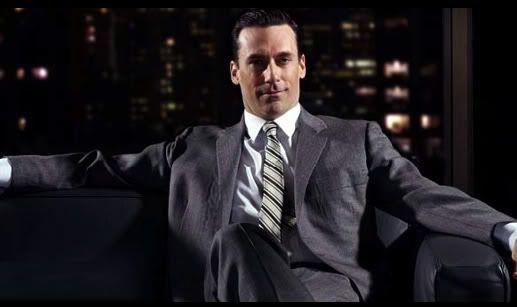
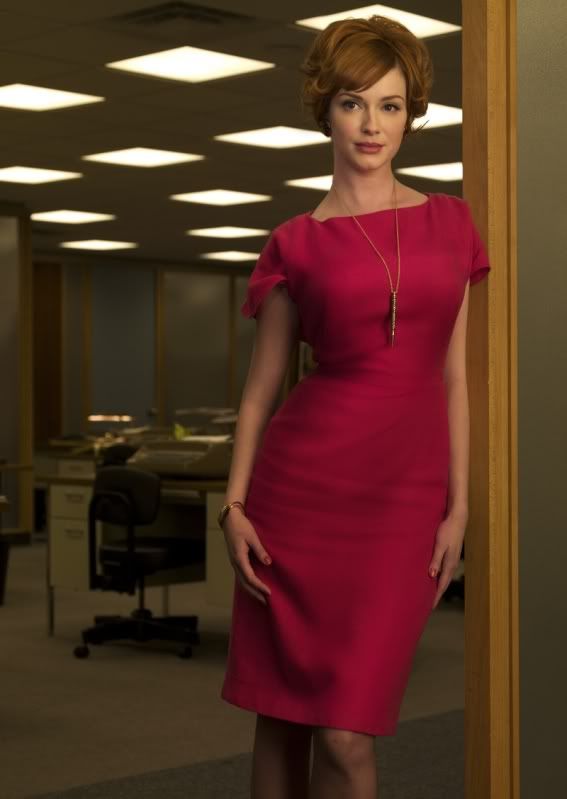
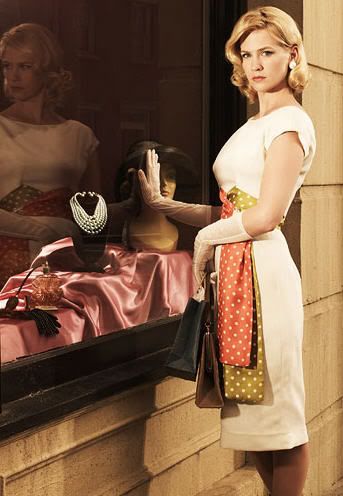
Also, the show is even prettier than LOST. The period outfits really help, but there sure are a lot of nice looking actors in this show. John Hamm, Christina Hendricks and January Jones really lead the list here, but everyone in the show is at least interesting or good to look at. In addition, the houses and work spaces are also works of art in themselves. There aren't a lot of sets, but the creators work with what they have and create a realistic, and beautiful, recreation of early 60s America.

Often, the writers will add lines or scenes that seem to be winking at the audience. The characters are constantly drinking (even while pregnant), smoking and doing all sorts of things that we would now consider unhealthy. The show also adds lines about technology or the characters current understanding of the world, trying to goad us into chuckling at the silly people stuck in the past. This is a little gratuitous in the first couple of episodes, but gets a little more subtle as the show goes on. It's one thing to make social commentary on a way of life, but it's entirely another thing to try to make us laugh at the old people using type writers.

Furthermore, the abuse of women in this show sometimes borders on gratuitous. I know that women were treated badly during that time, especially by the rich, but there are many painful shots in this show of men laughing about a women thinking or treating them as pure objects. You have the neurotic cheated on housewives, the abused (verbally and sexually) secretaries at work, and even the 'strongest' woman character in the show is constantly undermined by her father. The triumphs for the women in this show are few and far between, and I hope they get a little more room to shine in future seasons.

Above all, I really think that Mad Men is just like a well written, period soap opera. You could make the case that a show with any kind of continuity is just a dressed up soap opera, but I think this really rings true for Mad Men. As much as the show might be an investigation into the culture of the upper crust in the 60s, the show is really just about individual people's lives. The show isn't continuity obsessed, there aren't any real cliffhangers or 'to be continued....' scenes, but the season really flows as one story. We are introduced to secret love affairs, long lost brothers, hidden pasts, scheming villains and hidden sexuality. These things are all long standing staples of the soap opera genre, and Mad Men uses them to its advantage.

Calling Mad Men a soap opera isn't to dismiss it. Nor is it to suggest that it's just a glossy soap opera like The OC. It's an extremely well written and produced show that is rightful well respected within the television world. It also just happens to share much in terms of plot and content with many day time soap operas.

8/04/2009

Killing Yourself to Live - Chuck Klosterman


I didn't plan on reading a book written by a rock journalist immediately after reviewing the most prominent movie made about a rock journalist, but sometimes these things just happen. I have heard of Chuck Klosterman for quite some time, but have never really looked into him or his books. It makes sense that I would review a book written by one of the more well known commentators of pop culture for this blog, so I'm glad I happened to see this book in a friends bathroom and be able to snag it before he left town.

In Killing Yourself to Live Chuck sets out to visit places where famous musicians died and to make some kind of point about death being a good 'career move' for rock stars In practicality this book is only partially about this. The book ends up being 1/3 about dead rock stars, 1/3 Klosterman's observations about music and pop culture as a whole, and 1/3 discussions on ladies that he is currently entangled with or ladies he wants to be entangled with. The first two sections of this book are pure gold, and the last not so much.

It's not that his problem with having multiple love interests isn't relateable (hey, we've all been there). It's just that his other writing is so great that listening to him talk about relationship issues isn't nearly as interesting as his thoughts on rock music. I think memoirs have this problem in general: relationships that are so very important for the author are of little interest to the reader. The same thing happens in Nathan Rabin's book in that the parts of his life that may be the most important to him (his girlfriends) really aren't that interesting to anyone else.

But this is all really beside the point. The rest of the book is fantastic, and it's not like the girlfriend talk takes anything away from it (there are no Penny Lanes), it really just pads the text so that it's actually book length.

He rents a car and travels across the country in 20 or so days to visit these famous sites. And when I say across the country he really goes across the country. He starts out in the northeast (he currently lives in in New York City) and heads down south, then up through the Midwest, and then west across Montana to Seattle. It's an epic amount of driving, and he does the whole thing with only 600 cds to keep him company.

Something that is very refreshing about Klosterman is his Midwest sensibility. He's from North Dakota and even though he lives in NYC for work purposes, he's still very much a Midwestern boy. He's constantly going out to eat at the Olive Garden and Bennigans while he's on the road, and reminisces about his high school football days. But the thing that really stands out is his critique of hipsters and irony. While visiting the club where the tragic Great White concert occurred, he makes these remarks about the show:

"To me, that's what makes the Great White tragedy even sadder than it logically was: One can safely assume that none of the 100 people who died at the Station that night were trying to be cool by watching Great White play 20-year-old songs. This was not a bunch of hipsters trying to be seen by other hipsters..."

Klosterman constantly criticizes hipsters and the music they embrace, if they can truly be thought of as genuinely embracing anything, because he finds it disengenuious. To be sure, Klosterman has suspect taste himself, but whether it's his defense of Rod Stewart or his love of KISS (including their solo albums) he's genuine about everything. "Why would I want other people to think I like something I do not actually like? What possible purpose would that serve?" says Klosterman. He has a pretty good point and even though most people don't agree with his tastes (KISS? Really?) at least he's honest and genuine.

In my favorite section of the book, Klosterman spends 3 pages trying to describe why Led Zeppelin is a timeless band that is loved differently than other other band in history. He agrees that the Beatles and The Rolling Stones may be better, but Zeppelin has something that makes them special. A couple of quotes from this section:

"Led Zeppelin is the most legitimately timeless musical entity of the past half century; they are the only group in the history of rock 'n' roll that every male rock fan seems to experience in exactly the same way."

"There is a point in the male maturation process when the music of Led Zeppelin sounds like the perfect actualization of the perfectly cool you"

And about the time that every male goes through the 'Led Zeppelin phase" what they say to themselves:

"This shit is perfect. In fact, this record is vastly superior to all other forms of music on the entire planet, so this is all I will ever listen to, all the time."

Now he may be overstating this a little bit (I'm pretty sure I have male friends who don't really like Zepp) but I'm a little more likely to believe him because I went through a phase exactly like this. I went through a phase where I thought Zeppelin was the best band of all time, and that no one could come close to rocking as much as they do. In fact I revisit this stage every now and again and when I pick up old records (including Zeppelin) at my house next week I may enter this stage again.

Led Zeppelin rules.

Predictably, Klosterman ends his journey in Seattle to consider the death of Kurt Cobain. This makes sense, Cobain is the most famous rock star death for almost everyone in our generation (except a certain pop star who I'll get to in a second). Says Klosterman about Cobain's death and it's impact on society:

"Kurt Cobain had not merely made culturally important music--suddenly, he had made culture. His death became a catchall event for anyone who wanted their adolescence to have depth: It was not possible to achieve credibility simply by mourning retrospectively. Cobain's iconography hadn't changed that much, really; what changed was the number of people who suddenly thought Cobain's iconography said something about themselves."

I think his comments on this are extremely interesting, especially given current circumstances. Not only does Klosterman argue that people rewrite history about a dead star after their death, but they somehow try to connect with this death to find meaning in their own lives. People no longer though of Nirvana as being headed by an asshole drug addict, who didn't even make the most popular music of the time (that would be Pearl Jam). Everyone found Cobain tragic, and treated him like some kind of martyr.

This is exactly what everyone has been doing to Michael Jackson. No longer do we think of him as a possible pedophile that was just a big creepshow for the past 20 years. No longer do we consider that the person who made all of those awesome and genre breaking songs has been gone for quite some time. Everyone chose to rewrite history and remember him in their own way. And even more, people got so worked up and upset it seemed to affect their entire lives for days. I would like to read Klosterman's thoughts on the death of Jack-O because where for Cobain's death affected mainly young white men, Jackson pretty much made the news world stop for 2 weeks because everyone wanted to find meaning in their own lives and connect through his death.

8/02/2009

Almost Famous - Cameron Crowe


The impetus for me making my list of the best movies of the decade was Bill Simmons' similar discussion on his podcast and in a recent article. For him it came down to Almost Famous and The Dark Knight, with Almost Famous winning out mostly because it's been around longer and he had more time to consider it as one of his favorite movies. In making my list I ignored Almost Famous because frankly, when I first saw it I hated it. This movie came out in 2000 so it had been at least 8 years since I saw it and I was much younger at the time. I thought that the movie deserved reconsideration because so many people I know and respect love this movie.

Right from the beginning I could see why people so highly respect this movie. The dialog is incredibly well written, the movie is extremely well acted, and the soundtrack is amazing. Cameron Crowe put to good use his experience in writing for Rolling Stone to be able to make the rock stars come to life as real and interesting people. Billy Cruddup and Jason Lee are perfect as the feuding bandmates, and as usual Philip Symour Hoffman steals every scene he is in as the local film critic in young William's hometown. And if that's not enough, Frances McDormand knocks her role out of the park as her portrayal of William's overprotective mother. In fact my favorite scene of the movie might be when William's mother dressed down Cruddup's Russell Hammond for leading her son astray and for not living a very respectable life.

So far it seems like I loved Almost Famous almost as much as Bill Simmons does, but I have one sticking point with the movie, and it's a major one. I cannot stand the character of Penny Lane played by Kate Hudson. It's not that Hudson does a bad job, she sells the role perfectly well, I just find everything about to character to be REALLY lame. This starts with her posturing at the beginning of the film with a phony name and superiority about being not a groupie but a 'band-aid'. It only gets worse when she does things like tell William that they are going to move to Morocco and leads him on while pinning for the lead guitarist, Russell. I know we're supposed to see through her facade at least a little bit, but I find her utterly deplorable.

This might be the result of the fact that I have never appreciated or respected idolatry, especially of rock stars. I really love good music, but I have never really found most of the people behind it interesting at all (except in rare cases like David Bowie) and don't understand people who try to become groupies. Penny Lane's goal in this movie is to hang out with rockstars, pretend to be more than a mere groupie and thus looks down on the other girls, and to lead a glamorous lifestyle to which she adds nothing. She claims to love the music and this is what separates her from the other girls, and yet we never hear of her discussing music. Her conversation completely revolves around gossiping about rockstars and talking about 'the life'.

I hated her and her friends so much that anytime there was a scene involving them I would audibly groan and roll my eyes. They were just so annoying for the entire movie and I couldn't get past it. For me, they ruined any scene they were in. Maybe I will soften on this stance as I get older seeing that I believe this is the reason I hated this movie in it's entirety when I was a teenager and now I only hate 1/5 off it. I can see why people would love this movie so much, and I can even respect someone who thinks of this as their favorite movie of the decade but for now I consider Almost Famous part spectacular film and part incredible annoyance